
Bitcoin Faces Significant Monthly Decline Amid Market Turmoil
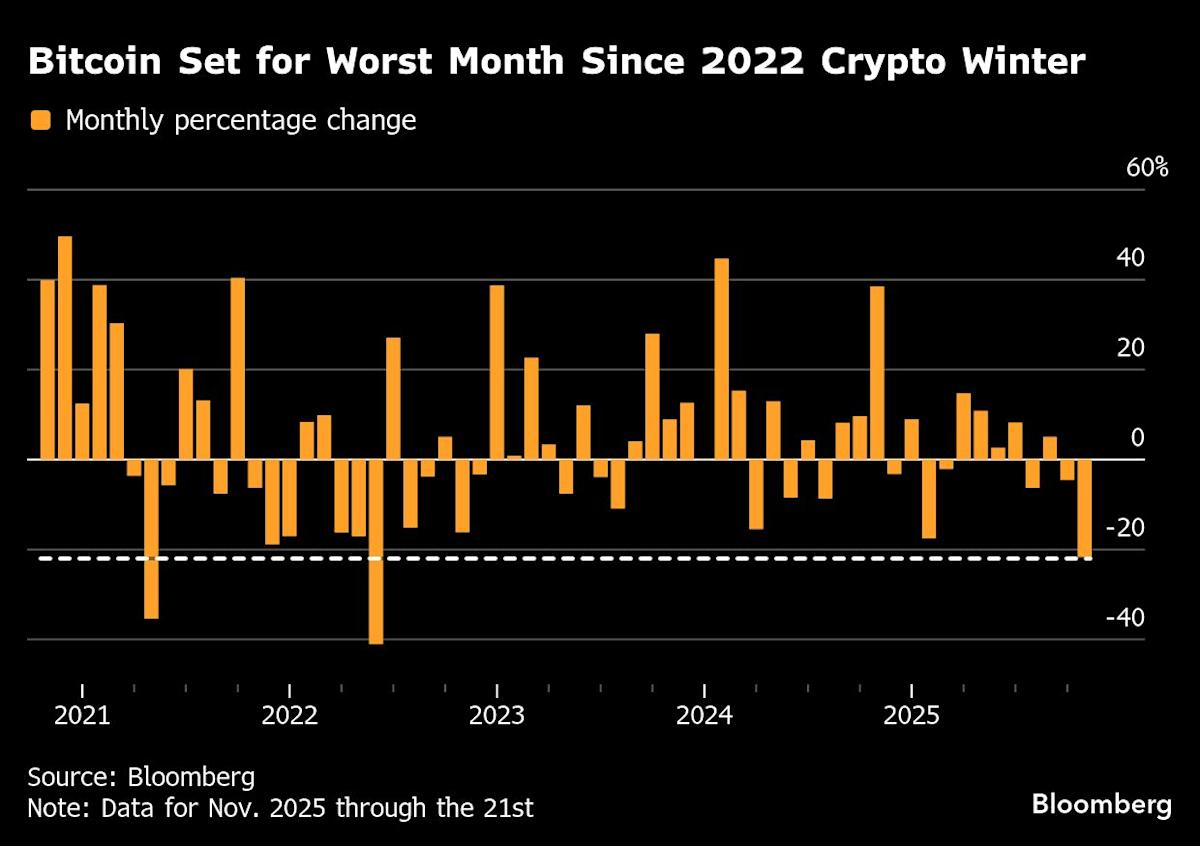
Bitcoin is poised to experience its most considerable monthly decline since a series of corporate failures shook the cryptocurrency industry in 2022. The leading digital currency saw a drop of up to 7.6%, reaching $80,553, before slightly recovering on Friday. Meanwhile, Ether, the second-largest cryptocurrency, fell by as much as 8.9%, slipping below $2,700, accompanied by declines in numerous smaller cryptocurrencies. As reported by CoinGecko, the overall market capitalization of cryptocurrencies has fallen below $3 trillion for the first time since April.
Bitcoin Suffers Major Losses This Month
In November, Bitcoin has lost approximately 25% of its value, marking its most significant monthly decrease since June 2022, according to Bloomberg data. This decline can be traced back to the collapse of Do Kwon’s TerraUSD stablecoin project in May 2022, which initiated a chain reaction of corporate failures culminating in the collapse of Sam Bankman-Fried’s FTX exchange. Despite a supportive pro-crypto stance from the administration of former U.S. President Donald Trump and increasing institutional interest, Bitcoin has plummeted over 30% since reaching an all-time high in early October. The downturn was exacerbated by a massive liquidation event on October 10, which resulted in $19 billion being wiped out in leveraged token positions and erased around $1.5 trillion from the total cryptocurrency market value.
Market Vulnerability Heightened by Forced Sales
Chris Newhouse, director of research at Ergonia, a decentralized finance firm, commented on the current market conditions, noting that a combination of forced liquidations and structural selling related to exchange-traded funds (ETFs) has left the market in a particularly precarious state. Any attempts to stabilize prices are quickly met with additional selling pressure from multiple sources. In the last 24 hours alone, selling pressure escalated, with an additional $2 billion in leveraged positions liquidated, according to CoinGlass data.
Challenges in the Broader Market Impact Cryptocurrency
The overall market environment has not been favorable for cryptocurrencies. Following a rally in U.S. stocks driven by renewed excitement for artificial intelligence after positive earnings reports from Nvidia Corp., stock prices reversed gains late Thursday due to concerns over inflated valuations and uncertainty surrounding potential Federal Reserve interest rate cuts in December. This volatility has made for a challenging landscape for investors.
Investor Sentiment at an All-Time Low
Pratik Kala, a portfolio manager at Apollo Crypto in Australia, remarked that market sentiment is extremely pessimistic. There seems to be a significant forced seller presence, but the depth of this selling remains uncertain. A crypto wallet known as “Owen Gunden,” which has held Bitcoin since 2011, began liquidating a total of $1.3 billion worth of Bitcoin in late October, selling its final holdings on Thursday, as reported by blockchain research firm Arkham Intelligence.
Noteworthy Selling Patterns Emerge
Vetle Lunde, head of research at K33, pointed out that while Owen Gunden’s selling may not be impactful in isolation—similar to recent ETF sell-offs—it effectively highlights a significant trend this year: long-term holders (OGs) are divesting substantial amounts of Bitcoin. Furthermore, a gauge tracking crypto investor sentiment, which considers factors such as volatility and demand, has dropped to its lowest point since the 2022 crash, indicating “extreme fear” among traders. This index was at a much higher level of 94 just after Trump’s presidential election victory over a year ago.
Institutional Investors Steer Clear of Weakness
Institutional investors appear hesitant to capitalize on the current downturn. On Thursday, a group of 12 Bitcoin exchange-traded funds listed in the U.S. experienced a staggering $903 million in net outflows, marking their second-largest single-day redemption since their launch in January 2024. Additionally, open interest in perpetual futures has decreased by 35% from its peak of $94 billion in October. Tony Sycamore, an analyst at IG Australia, suggested that the market might be testing the pain threshold of Strategy Inc., a firm known for its Bitcoin hoarding approach initiated by Michael Saylor. Strategy Inc.’s market-adjusted net asset value (mNAV), which reflects its enterprise value in relation to its Bitcoin holdings, has fallen to just over 1.2. Analysts at JPMorgan Chase & Co. have cautioned that Strategy could lose its position in key benchmarks like the MSCI USA and Nasdaq 100, with a decision expected by January 15.
Pressure Mounts on Imitators of Saylor’s Strategy
Other companies attempting to replicate Saylor’s Bitcoin accumulation strategy have also faced challenges. Firms such as Sequans Communications, ETHZilla, and FG Nexus have started selling portions of their Bitcoin holdings to finance stock buybacks aimed at bolstering their declining share prices. Bitcoin registered its 11th consecutive lower low on Friday, marking its longest streak of declines since 2010, according to Bloomberg data analysis.
Continued Risk Aversion in the Crypto Space
Bohan Jiang, a senior derivatives trader at FalconX, noted that many crypto investors have endured significant losses, resulting in a general aversion to risk. This has led to widespread de-risking across major cryptocurrencies and altcoins, as many market participants aim to protect their year-end results.


